2026 ILACP Conference Speakers

Keynote Speaker: Joshua Bitsko
"Police Resiliency and Critical Incident Mindset"

Thursday, April 30
8 a.m. - 12 p.m.


Presentation Title: Police Resiliency And Critical Incident Mindset Training
Presentation Description: Josh Bitsko was one of three officers who breached the suspect’s room during the 1 October Mass Shooting in Las Vegas, the deadliest mass shooting in U.S. history. That moment did not just test tactics. It tested the emotional core of what it means to be a first responder.

Fear, anxiety, and uncertainty are real, yet they are rarely talked about in law enforcement culture. Officers are trained to suppress these reactions, but those emotions still show up, in the moment and long after the incident ends. If we do not prepare our people for that emotional reality, we are setting them up to struggle when it matters most.

This course bridges the gap between tactics and mindset. Josh combines firsthand experience in high stakes critical incidents with real world insight, science based techniques, and practical tools officers can apply immediately. The training focuses on building personal resilience under pressure, improving decision making in real time, and strengthening the mental clarity needed to perform when everything is on the line.

Participants will learn:

  • What to expect emotionally before, during, and after a critical incident

  • Practical, science backed strategies to manage stress in real time

  • Tools to support recovery and build long term resilience

  • How to enhance tactical performance and stay mentally sharp under pressure

  • What agencies can do to support wellness and reduce internal stress that compounds trauma

This course is ideal for officers, supervisors, command staff, and peer support personnel who want to lead with clarity and build a culture that values both readiness and resilience.


Plenary Presentation: Chris Cowan
"Leveling up your leadership, 1 Degree; by LIVING your legacy, not leaving one"

Sponsored by Spike Stinger and CABT


Thursday, April 30
1:30 p.m. - 5 p.m.

  • Presentation title: Leveling up your leadership, 1 Degree; by LIVING your legacy, not leaving one
  • Presentation overview: Police leadership and management start with understanding the difference between success and significance and the difference between living a legacy and leaving a legacy.  So, what is your strategic and dynamic readiness to leveling up your leadership? Water boils at 212 degrees. It can cook at 211 degrees; it is successful at 211. What will it take for you to go from success to significance and level up your leadership that one degree. This professional development session will take you out of your comfort zone and challenge your thinking. We will help you build your capacity, your passion and purpose, your effectiveness as a leader and a clearer understanding of being a predictive and preparative leader. The presentation includes an interactive power point and session that will provide you with practical, applicable skills to being an executive who is better today than you were yesterday. Focusing on passion, purpose and the profession.


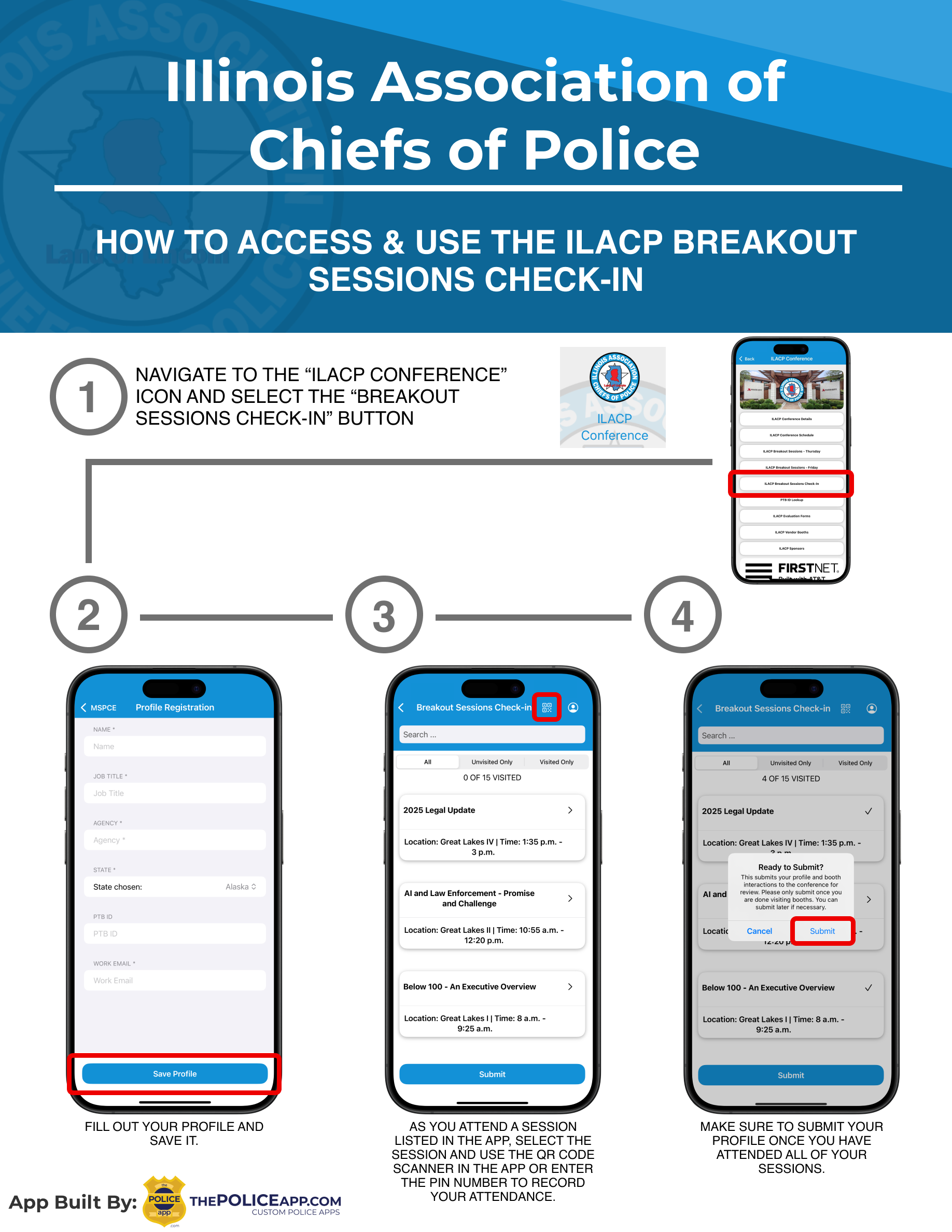
BREAKOUT SESSIONS

*As in previous years, breakout sessions will be sent to ILETSB for continued education credit hours and mandated training credits. 

FRIDAY, MAY 1

8 a.m. - 9:30 a.m. 

Course Title: Rethinking the Role of Traffic Stops – Is More Always Better?
Speakers: Pat Kreis, Darren Gault
Room: Plaza A

Course Description: Traffic enforcement is an important element of police work and often has a direct impact on the safety of our communities. However, not all traffic stops provide equal value. Certain types of traffic stops have become the target of police critics and it’s time we, as police leaders, engage in meaningful conversations about our historical practices. Are all traffic stops worth the cost? Do we even accept the costs of traffic stops? Is it time for us to consider and discuss a cost/benefit analysis of our traffic enforcement? This presentation will review experiences after some agencies have modified historical priorities regarding traffic enforcement. Additionally, have our historic practices regarding measuring individual officers’ traffic enforcement placed an unduly emphasis in police officer evaluation tools? Is it time to stop referring to “officer productivity” as if our officers are assembly workers manufacturing a product? This presentation will share one agency’s experience after ending all quantitative measures, including traffic stops, for police officer evaluations.

Course Title: Women's Leadership Section
Speakers: Tara Anderson, Heather Lencioni
Room: Plaza B

Course Description

Course Title: Stronger Hearts, Stronger Leaders: Tracking the #1 Killer Among Law Enforcement 
Speaker: Benjamin Stone
Room: Plaza C

Course Description: Dr. Stone will outline new and emerging trends in cardiac disease detection and will help listeners understand why traditional diagnostic methods are not effective in detecting unknown risk in populations of first responders.

  • Dr. Stone will present cutting-edge research being published in the field of occupational medicine that shows empirical evidence that a mis-identification of cardiac risk is largely responsible for the disparity between civilian and law-enforcement life expectancy.
  • Participants will be led step by step through a timeline of the processes of atherosclerosis (arterial plaque development) through the development of a heart attack.
  • Participants will also develop a profound understanding of what diagnostic resources are currently at their disposal for early detection or prevention of heart disease.
  • Dr. Stone will help patients understand the processes of “inflammation” specific to the coronary vasculature and how this process can be moderated with diet, changes in lifestyle, and medications.
  • Each participant will leave with a renewed understanding of the prerequisite diagnostics necessary to properly identify cardiac risk specific to occupations of public safety before the development of a bad outcome. 

Course Title:  All About Drones
Speaker: Anthony Bandiero
Room: Plaza D

Course Description: As drone technology becomes increasingly accessible to law enforcement, so does the responsibility to use it within constitutional boundaries. All About Drones is an essential course that explores the intersection of the Fourth Amendment and aerial surveillance. Officers and command staff will gain a clear understanding of when drone use becomes a “search” under constitutional law, and what legal thresholds must be met before deployment. The course covers key topics such as the use of drones to observe private backyards, the implications of aerial surveillance over curtilage, and the evolving legal standards governing emerging technologies. With real-world examples and practical guidance, this course ensures agencies stay ahead of legal challenges while leveraging drone capabilities effectively and lawfully. 

10 a.m. - 11:30 a.m. 

Course Title: Iron Sharpens Iron: Gratitude in the Face of Adversity
Speaker: Thomas Lemmer
Room: Plaza A

Course Description: This course expands our exploration of the Gratitude Leading Leadership Model. Policing is a challenging profession, in Chicago and everywhere else. The extent to which a police agency is able to meet its mission is impacted by the extent to which it is an environment that embraces gratitude. Human nature allows us to take on even the greatest challenges when we believe our efforts are appreciated. Is gratitude possible, even essential when things are difficult? After more than 34 years of active service in the Chicago Police Department adversity standouts as a point requiring far more instruction. In this life there is suffering and evil is real. In every life there will be trials and tribulations. Adversity tests our readiness and commitment, and reveals our character. Yes, we want our police officers to get through the trials that they will encounter. But, just getting through adversity should not be their goal or ours. Whenever adversity comes, we must remember and instruct that iron sharpens iron. Adversity provides the means from which endurance and strength can be built. Our communities are stronger and safer when our police officers endure adversity well and emerge stronger, with a renewed sense of faith and purpose. Police leaders at the supervisory excellence level foster these wellness lessons within their agencies. 

Course Title: Communicating During a Critical Incident
Speaker: David Guevara
Room: Plaza B

Course Description: Communicating During a Critical Incident is a 90-minute instructional presentation designed to equip law-enforcement leaders, public information officers, investigators, and supervisors with practical strategies for managing communication during high-profile and emotionally charged incidents. The course examines how communication decisions made in the earliest moments of a critical incident can directly influence public trust, media narratives, officer morale, and the long-term credibility of an agency. Drawing on nationally recognized crisis-communication principles from the U.S. Department of Justice COPS Office, this session blends lecture, media analysis, and guided discussion to explore both internal and external communication challenges. Participants will examine how misinformation spreads, how viral social-media narratives form, and how agencies can balance transparency with investigative integrity while operating under intense public and media scrutiny. The presentation is grounded in real-world case studies from the Aurora Police Department, including a firsthand analysis of a viral incident involving the presenter and a detailed review of a critical incident case study. Through timelines, holding statements, news releases, released footage, and media coverage, participants will evaluate what effective communication looks like in practice and how leadership messaging from chiefs and elected officials can reinforce transparency and accountability. 

Course Title: Building a Culture of Connection through Rescue Policing and the Law Enforcement Rescue Officer (LERO)
Speaker: Andrew Dennis
Room: Plaza C

Course Description

1. Shared Mission: Safety and Service

  • At its core, policing and public safety share a universal goal—protecting life.• Rescue-Based Policing (RBP) expands that mission from enforcement to care, empowering officers to act not only as protectors of law but preservers of life.
  • Law Enforcement Rescue Officers (LEROs) bridge enforcement and emergency medicine—responding faster, saving lives sooner, and connecting deeper with the people they serve.
  • Across the country, officers already perform rescues every day— administering Narcan, stopping bleeding, delivering CPR, and comforting those in crisis.
  • Recognizing and formalizing this role redefines the badge as a symbol of compassion, courage, and community trust.

2. Officer Wellness and Mental Fortitude

  • Helping others is protective for the helper.
  • When officers are equipped and trained to act—to save a life instead of waiting helplessly— they gain confidence, resilience, and renewed purpose.
  • Lifesaving skills (EMR/EMT, Stop the Bleed, CPR/AED, Narcan, TECC) strengthen mental wellness by replacing stress and helplessness with competence and pride.
  • Departments that integrate rescue roles report better morale, improved retention, and lower burnout.
  • Empowered officers see themselves not as enforcers under scrutiny but as guardians and healers—a shift that restores dignity and hope within the profession.

4. Recruitment, Retention, and the Future of Public Safety

  • The LERO model attracts a new generation of service-minded recruits—people drawn to teamwork, empathy, and action.
  • For current officers, adding rescue capabilities renews meaning and motivation, reinforcing why they chose this profession.
  • Training costs are manageable through shared EMS partnerships, grants, and hospital collaborations, making this model achievable and sustainable.
  • RBP is already proven across the U.S.—from the NYPD Emergency Services Unit to Genessee County Sheriff’s Office, to the Los Angeles County Sheriff’s Special Enforcement Bureau—each showing that when rescue is central, trust follows.

5. Community Trust and Connection through engagement

  • When the public sees officers teaching first aid in schools, hosting CPR trainings at churches, or leading Stop the Bleed programs at community events, they see neighbors—not strangers.
  • Each act of rescue becomes a shared moment of humanity, turning distance into partnership and fear into familiarity.
  • Initiatives like the Illinois State Police EMS program and Monmouth County’s Med Starshow that blending law enforcement with rescue deepens public trust and transparency.
  • Collaboration replaces confrontation: when people witness officers saving lives, they remember that the purpose of the badge is care. A New Vision of Policing Rescue is not a departure from law enforcement—it’s a return to its purpose. When every911 call is met with compassion and competence, we transform crisis into connection. From LEO to LERO to Hero, this model turns protection into partnership—and brings care back to the center of public safety. 

Course Title: ILETSB Presentation
Speaker: Anthony Cobb, Paul Petty
Room: Plaza D

Course Description


12:45 p.m. - 1:45 p.m. 

Course Title: See Spot Serve: Utilizing Therapy Canines In Crisis Response and Peer Support 
Speakers: Jennifer Wooldridge, Jerry Roman, Curtis Schwartzkopf
Room: Plaza A

Course Description: Establishing a therapy canine crisis response program is a great way to undertake operational coordination between officers, dispatchers, and community coordinators. Successful deployments of the canine teams offer an excellent opportunity to attain recognition in the community and good press with simple interactions. These, in turn, increase awareness and expand calls for service. The presentation identifies areas where partnerships can be made between law enforcement and advocates and demonstrates how officers can take ownership of crisis calls with the assistance of a canine. This creates an opportunity to foster networking among those incorporating new techniques in crisis response in alignment with the provisions of PA 104-106 which establishes standardized trainings and assessments in this area. This recent change in the Police Training Act makes Illinois the first state in the nation to offer specialty certification of this nature.

Course Title: Understanding FRO
Speakers: Dr. Mark Lahr, Zachary Kettelkamp 
Room: Plaza B

Course Description: The Illinois State Police (ISP), Office of Firearms Safety (OFS) launched the Firearms Restraining Order (FRO) Outreach and Training Program, a new statewide initiative designed to Strengthen public safety and save lives. Through this program, OFS will provide training and education to law enforcement agencies, school administrators, and community resource centers across Illinois. The goal is to raise awareness of Firearms Restraining Orders as a viable tool for preventing gun violence and self-harm, while also ensuring that those who may petition for or enforce a FRO have the knowledge and resources to do so effectively. The program will also work to promote statewide consistency in how FROs are implemented. Special attention will be given to addressing inequities, ensuring that high-risk individuals and communities facing barriers to support have access and information to the protection FROs can provide. This initiative reflects the Illinois State Police’s commitment to preventing tragedies before they occur and fostering strong partnerships with communities across the state.

Course Title: Evidence-Based Patrol Staffing: From Data to Deployment
Speaker: Lori Frank
Room: Plaza C

Course Description: Effective patrol staffing is a persistent operational challenge for law enforcement agencies. While recruitment and retention are vital, the immediate pressure lies in optimizing deployment and managing workload efficiently with existing personnel, especially amidst widespread staffing constraints. This presentation equips you with the evidence-based framework essential for today's policing environment. Patrol operations consume substantial resources, yet staffing decisions frequently rely on institutional habits or simplistic metrics rather than solid data analysis. This can lead to inefficient resource allocation, officer burnout, and deployment strategies misaligned with actual community demand. In an era of tight budgets and staffing shortages, the need for sophisticated, data-driven deployment strategies has never been more critical. Agency leadership is uniquely positioned to champion this transformation. This workshop provides a practical application of analytical techniques specifically for patrol staffing. We address the crucial question: How do we measure and analyze the specific demands on patrol officers and use that data to inform effective deployment to achieve strategic organizational goals?

Course Title: Are you ready for an officer involved shooting?
Speaker: Jeremy Thayer
Room: Plaza D

Course Description: This training course will provide an overview of procedures, policies, and best practices when it comes to preparing for or responding to officer involved critical incidents, like an on-duty shooting. Relevant use of force laws will be discussed as they pertain to officer involved critical incidents. As well, the course will examine the history of officer involved critical incidents and how recent events have shaped the law enforcement response to deadly force encounters. Furthermore, the course will talk about human performance factors and how they affect the officer, supervisor, and agency during a critical incident. 


2:15 p.m. - 3:45 p.m.

Course Title: Everything You Wanted to Know about ILEAP Accreditation
Speaker: Jeff Hamer
Room: Plaza A

Course Description: This session will focus on the information needed for Department decision makers to make choices in regards to pursuing ILEAP Accreditation. ILEAP Director Jeff Hamer will discuss grant opportunities for new agencies. This will include details on costs as well as software considerations. There will be plenty of time for question and answers as well.

Course Title: Building a Police Jiu-Jitsu Program: A Practical Guide for Municipal Departments
Speakers: Mike Weitzel, Kerry Murakami 
Room: Plaza B

Course Description: Police departments continue to face increasing expectations to reduce injuries, minimize use-of-force, and manage organizational risk while still maintaining effective control during arrests and resistance. This session presents a practical, municipal-level model for implementing a Police Jiu- Jitsu program as a tool for harm reduction, injury prevention, and improved use-of-force outcomes. Attendees will examine how grappling-based control skills can reduce reliance on strikes and higher-level force options, lower officer and subject injuries, and contribute to improved post-incident reviews. In addition, the session will explore secondary but critical benefits of a jiu-jitsu-based training model, including improved stress inoculation, enhanced decision-making under pressure, increased confidence during physical encounters, and greater emotional regulation during rapidly evolving incidents. The session will also address risk-management considerations, training frequency, and common pitfalls agencies might encounter when introducing a program. 

Course Title: All About Artificial Intelligence
Speaker: 
Room: Plaza C

Course Description

Course Title: 2026 Legal Update
Speakers: Don Zoufal 
Room: Plaza D

Course Description: An interactive session with information on and questions about the most recent legal issues facing law enforcement.  This may include labor issues, use of force, fitness for duty, etc.  This is done by a team of presenters.